
Silos and stockpiles are the hardest level application there is: airborne dust, an uneven, cone-shaped surface, long ranges and a vibrating, metallic wall. A wide beam reads the wall or the pile, not the true level.
Quoted from Grain & Bulk Solids Level Sensing.
Every transmitter ships with 4-20mA and RS485/Modbus as standard. Our radar transmitters achieve accuracy down to ±1 mm and output over 4-20mA, RS485/Modbus, or 4G wireless — with no contact with the measured medium.
Model list, output and specification quoted from the Radar Level Transmitter product page.
The 1.5-inch 80G radar level transmitter (model JJY-YLD128HS-1.5) was installed on a grain silo to measure the level of soybeans. The measured height was inaccurate — the reported level did not match the real fill height.
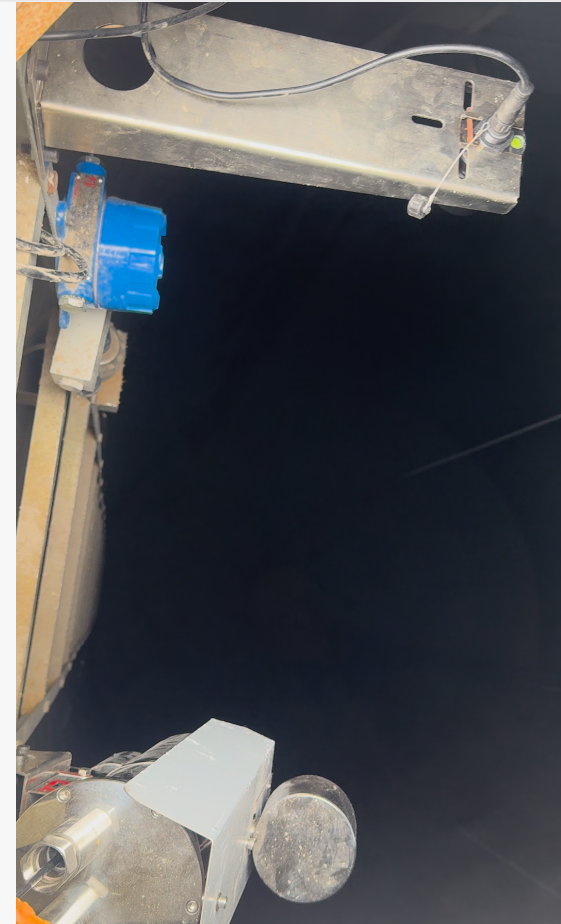
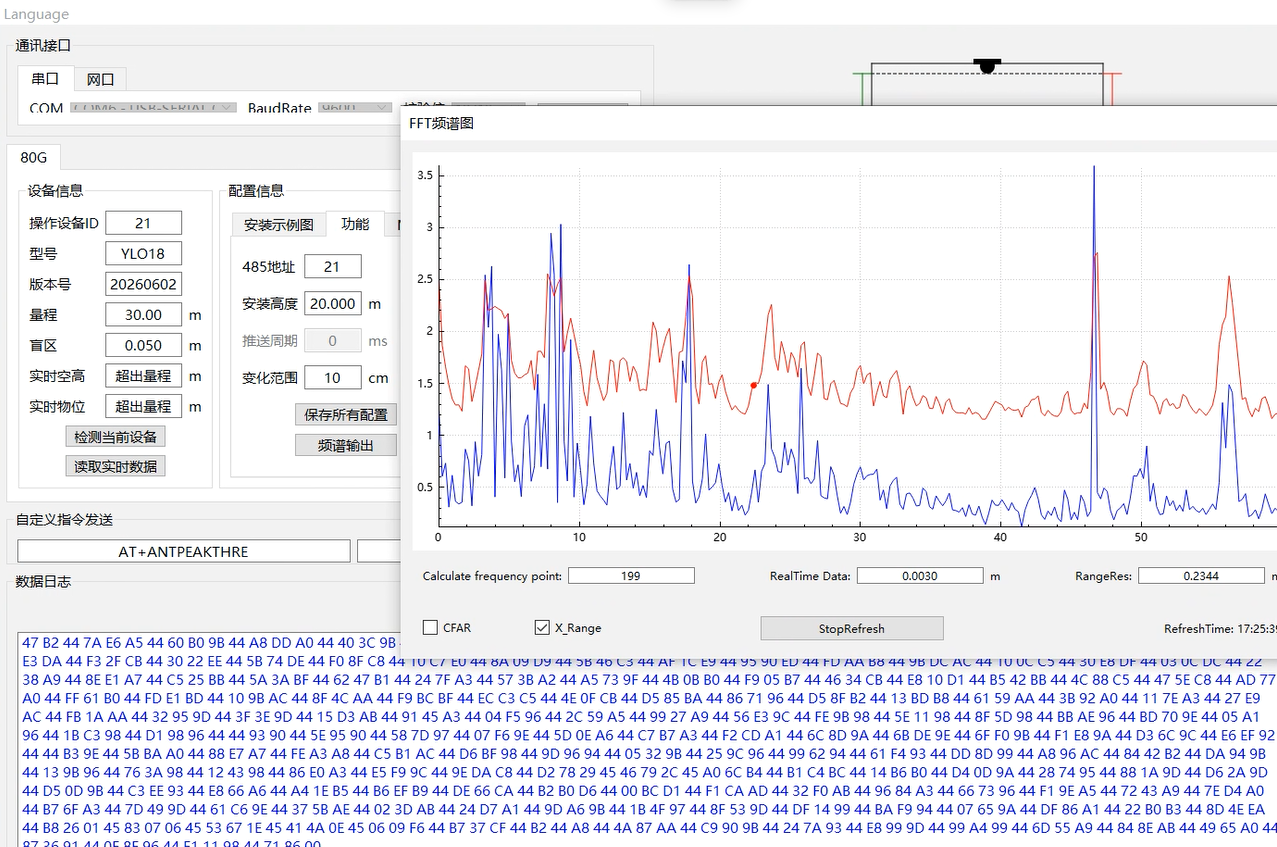
Root cause: Granular products return weaker and more scattered echoes than liquids: the surface is loose and uneven, the fill forms a cone, and dust attenuates the signal. With the default antenna peak threshold (100), noise and secondary peaks compete with the true surface echo, and the default installation type and blind zone do not match a suspended installation above bulk solids.
Solution — field-proven parameters: Raise the antenna peak threshold from 100 to 150, switch the installation type to suspended installation, and enlarge the blind zone to 0.3 m.
After these changes the measured soybean level matched the actual fill height.
Full walk-through with echo spectrum: Why is the 1.5-inch 80G radar level reading inaccurate for grain?
Wall clearance calculation formula: H = R / tan(beam angle), where H = measuring height and R = minimum wall clearance distance. tan(2.75°) ≈ 0.04.
Example: for a 7 m measuring height, R = 7 × 0.04 = 0.28 m. A minimum wall clearance of 28 cm prevents radar beams from hitting silo walls.
Quoted from Can the ±2.75° beam angle be reduced?
Editor’s note: all six cases below are liquid applications, not bins. They are listed because they share one root cause with bulk solids — an echo arriving from somewhere other than the product surface.
Titles and outcomes quoted from Field Cases.
No. At 80 GHz the beam is too narrow to be scattered by typical grain or flour dust, and the antenna self-cleans. Ultrasonic, by contrast, is strongly attenuated by dust.
Keep the beam clear of the wall over the full measurement range. Our beam-angle guide gives the minimum distance for your silo diameter and antenna.
Up to ±1 mm on 80 GHz FMCW; ranges beyond 30 m; narrow 3-degree beam avoids tank internals.
First two answers quoted from Grain & Bulk Solids; third from the Radar Level Transmitter page.

Copyright @ 2026 JiaJia Eye

Scan to add WeChat