Vegetable Oil Reads 4.5× Too High: Removing a Double-Reflection Echo

You are here : Home > Radar & Ultrasonic Level Meter FAQ Hub > Radar Level Sensor Field Cases: Real Sites, Real Fixes > Vegetable Oil Reads 4.5× Too High: Removing a Double-Reflection Echo
Industry: food & beverage processing
Application: vegetable oil level in a small vessel
Device: JJY-YGD38M-18L radar level transmitter
Symptom: 0.462 m reported against a real empty distance of 0.102 m
Recorded: 11 October 2026 · Shenzhen, China · Field support: Ye, Application Engineer

The problem

Site & symptom

The transmitter was mounted over a vessel of vegetable oil at a production line test station. The real empty distance – antenna to oil surface – was 0.102 m. The unit reported 0.462 m, roughly 4.5 times the true value, and the number was steady rather than erratic.

Root cause

The first hypothesis was the dielectric constant. A liquid with a low εr reflects less energy, and vegetable oil is not water. But the measured value for this oil was εr ≈ 6.8, which reflects radar energy perfectly well – so dielectric loss was ruled out as the cause of a stable, larger reading. A weak return makes a unit under-read or drop out; it does not make it read 4.5× too far.

The ratio was the clue. A reading that lands at a simple multiple of the real distance is the signature of multipath: the beam leaves the antenna, reflects off the oil, and a second path – off the vessel wall, an insert, or the antenna itself – returns a second echo later in time. The unit reports the later echo as a longer distance.

At 0.102 m the two echoes are only centimetres apart, and the RF output was set to its maximum power step. With that much energy in the near field, the secondary echo crossed the detection threshold and was picked as the surface.
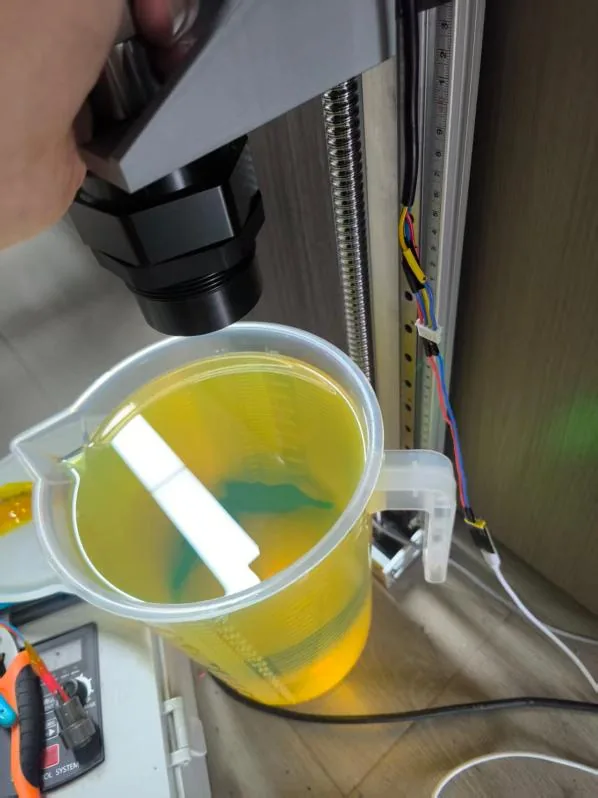
The installation

Radar level transmitter above a vessel of vegetable oil at a very short standoff distance
Field case – the antenna only 0.102 m above the oil surface. At this standoff, the near field dominates the echo trace.

How we fixed it

Solution

Lowered the RF output to the minimum power step in the Bluetooth configuration app; the mounting was left untouched.

Result

The secondary echo fell below the threshold, the unit locked onto the oil surface, and the reported level matched the real 0.102 m. The waveform after the change shows a single clean peak.
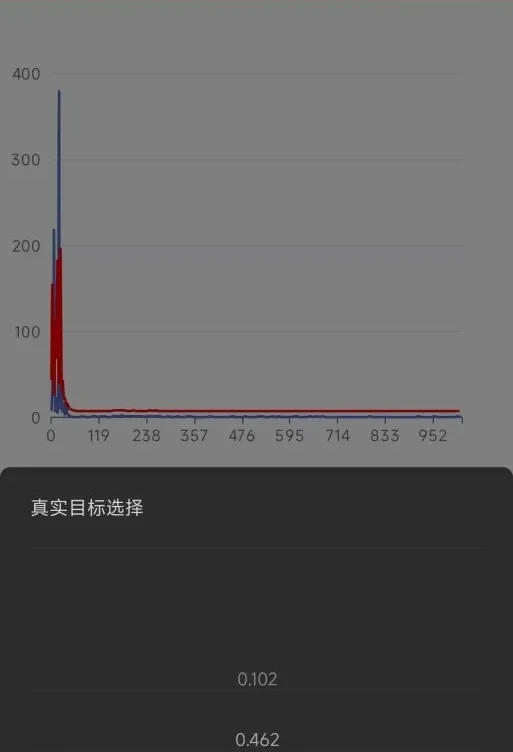
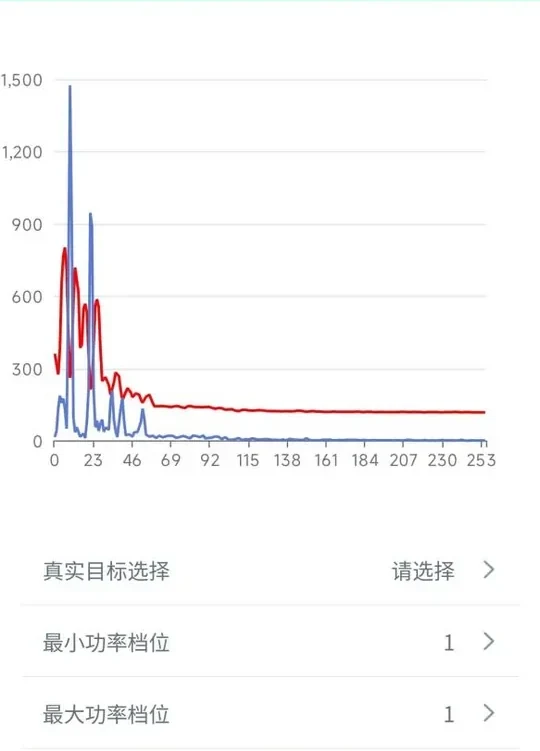
Echo spectrum: before and after

Echo spectrum before the fix, dominated by a strong near-range echo with additional secondary peaks
Before – a strong near-range echo plus secondary returns; the unit picks the wrong one.
Echo spectrum after lowering RF power to the minimum step: a single clean peak at the oil surface
After – RF power reduced to the minimum step; one clean peak remains.

What this case teaches

  • A stable multiple of the true distance means multipath, not a weak signal. Check the ratio before you touch the dielectric settings.
  • Short standoff is a power problem, not a resolution problem. With the antenna centimetres from the product, maximum RF output guarantees near-field saturation.
  • We lost no time on dielectric here: εr 6.8 reflects radar perfectly well. A weak return makes a unit under-read or drop out – it does not make it read 4.5× too far.

If the antenna sits within a few centimetres of the product, the power step and the blind zone have to be set at commissioning – not after the first bad reading. Send us the standoff distance and the vessel internals and we will give you both numbers.

Talk to an application engineer

Copyright @ 2026 JiaJia Eye

Weixin
No:89470
WhatsApp Inquiry Email WeChat
× WeChat QR code

Scan to add WeChat