
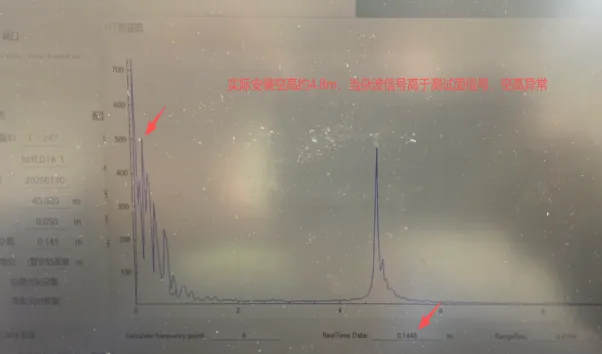
The transmitter was installed on a river bank. The empty distance to the water was about 4.8 m. The reading was unstable, and every so often it dropped to 0.14 m before recovering.
The site photo explains it. The bank is a slope, and the transmitter was mounted at an angle to match it. On site it looked square: the antenna and the water appeared level with each other. They are not the same thing – the beam axis was not normal to the water surface, so a large part of the transmitted energy was scattered forward instead of back to the antenna.
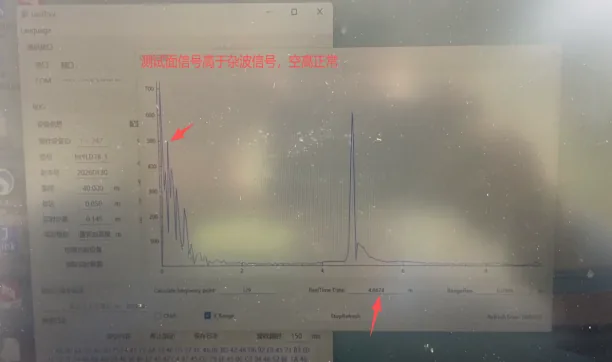
The echo spectrum confirmed a weak return rather than a missing one. The likely contributors were the mounting pole and the housing sitting inside the beam path, both of which return energy close to the antenna.
That is the mechanism behind the 0.14 m spikes: the true water echo was marginal, so whenever it faded, the unit locked onto the nearest available reflection – the pole or the housing – and reported it.
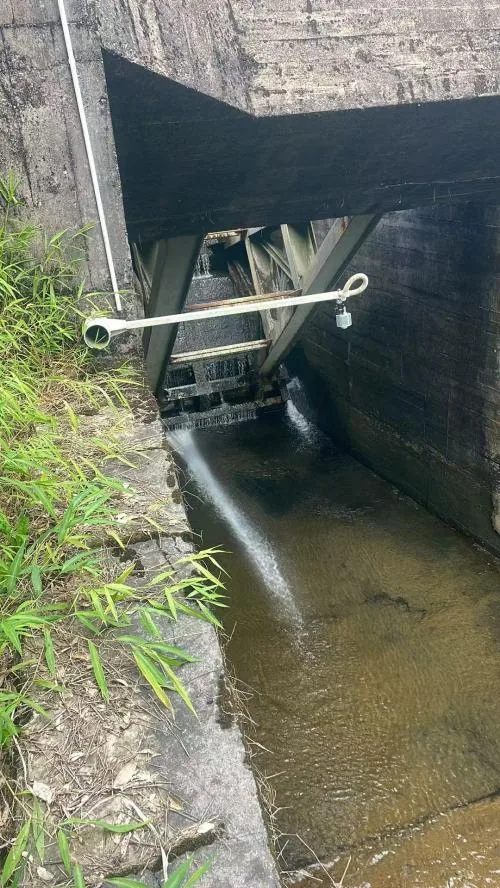
Two changes: (1) switched to suspended installation, moving the antenna clear of the mounting hardware so the pole and housing left the beam path; (2) increased the blind zone by 0.2 m so near-range reflections from the structure are ignored rather than reported as level.
The reading stopped jumping and the echo waveform returned to normal. No change to the product, the range setting or the output scaling was needed.
Send us a photo of the bank taken from the side, plus the empty distance. We will tell you whether the beam is normal to the water before anyone climbs the pole.

Copyright @ 2026 JiaJia Eye

Scan to add WeChat