51 cm Reported Against 28 cm: A Second Echo in a Short-Range Tank

You are here : Home > Radar & Ultrasonic Level Meter FAQ Hub > Radar Level Sensor Field Cases: Real Sites, Real Fixes > 51 cm Reported Against 28 cm: A Second Echo in a Short-Range Tank
Application: short-range level in an open tank
Device: JJY-YLD128D-W-32 radar level transmitter
Mounting height: 80 cm
Symptom: reads 51 cm where the real empty distance is 28 cm
Recorded: 13 November 2026

The problem

Site & symptom

The unit was mounted 80 cm above the liquid. The real empty distance – antenna to surface – was 28 cm, but the transmitter reported 51 cm. That is not a small offset: the unit was describing a surface 23 cm lower than the one in front of it.

Nothing on the site had changed. The reading was simply wrong from the start of the shift.

Root cause

The echo spectrum showed a second echo next to the real one.

At 28 cm of empty distance there is almost no time separation between the surface echo and the echo that bounces back a second time. The two arrive close together, and the unit locked onto the second one – which corresponds to a longer distance, hence the 51 cm reading.

Two of the usual recovery paths were tried and neither worked: switching on the nearest frequency point setting, and re-learning the echo. Both failed to reach the real target. A restart of the unit did.
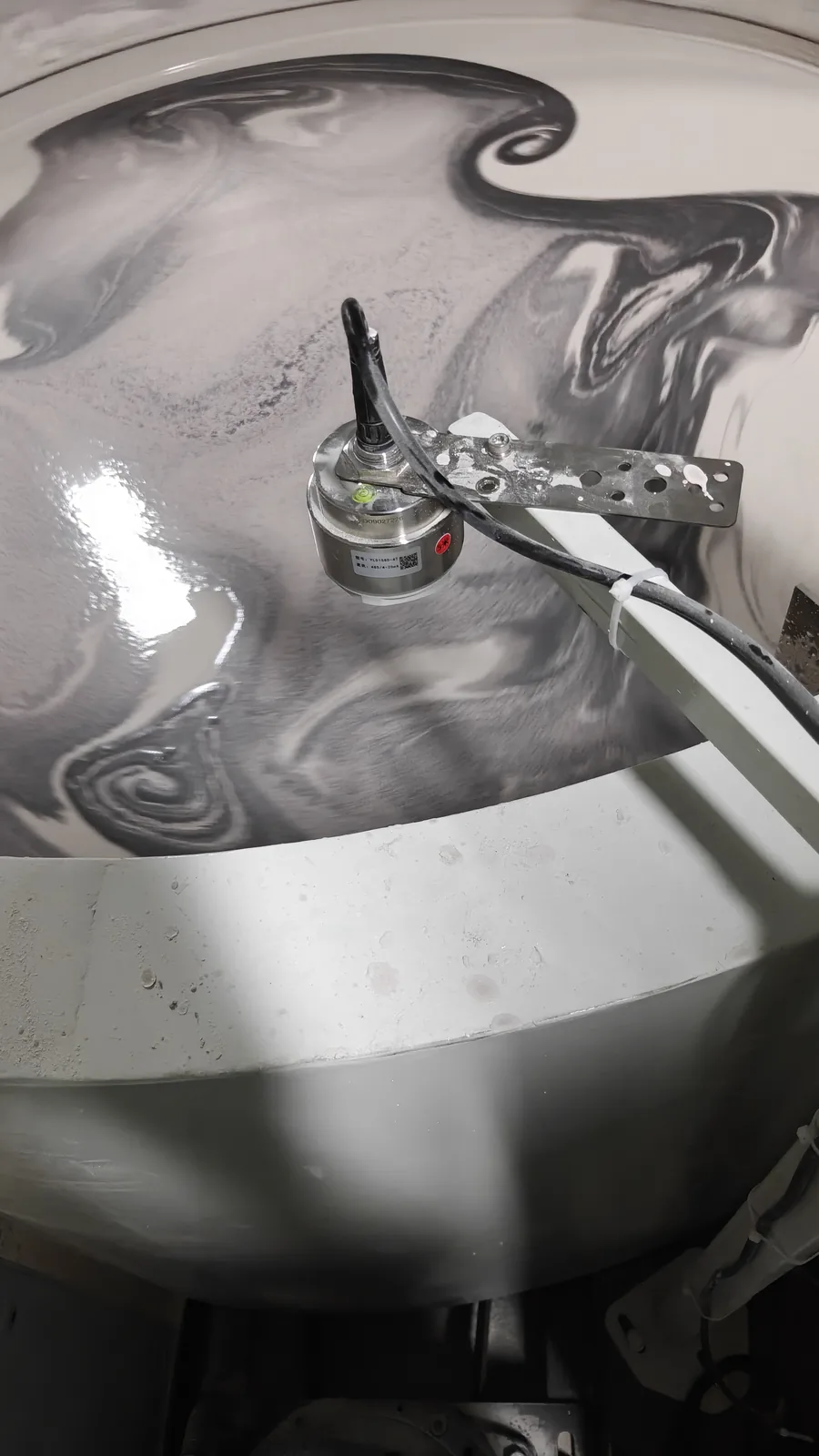
The installation

Radar level transmitter on a bracket just above the liquid surface in a shallow open tank
Field case – the JJY-YLD128D-W-32 on its bracket, with the liquid surface close under the antenna. The short distance is the whole difficulty: the surface and its second reflection arrive almost together.

How we fixed it

Solution

The nearest-frequency-point setting and echo learning were both applied and neither recovered the real target. A restart of the transmitter made it acquire the real surface echo again, and the reading came back to 28 cm.

Two mounting rules came out of the visit and went back to the customer: keep the antenna vertical and square to the surface to cut the second reflection, and where the measurement is this short, raise the mounting height so the surface sits farther from the antenna.

Result

Correct level at the working height, and a spectrum reduced to one dominant peak. The vertical scale on the capture also dropped from 1,500 to 400 between the two screenshots, which is the real measure of how much of the return was second echo.
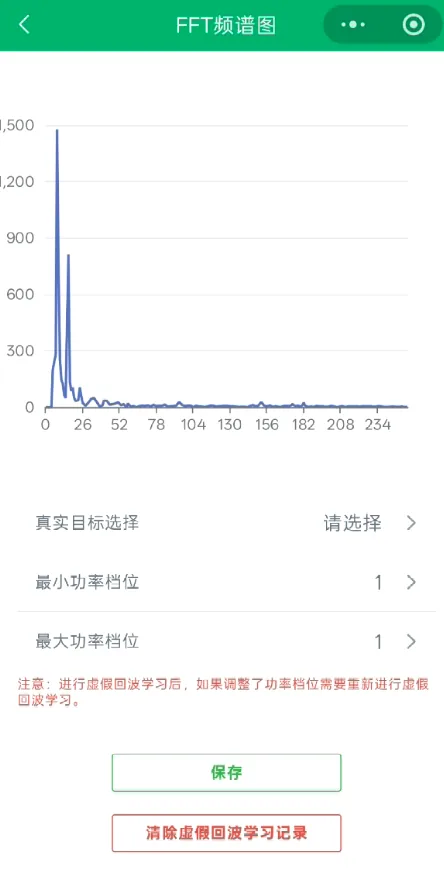
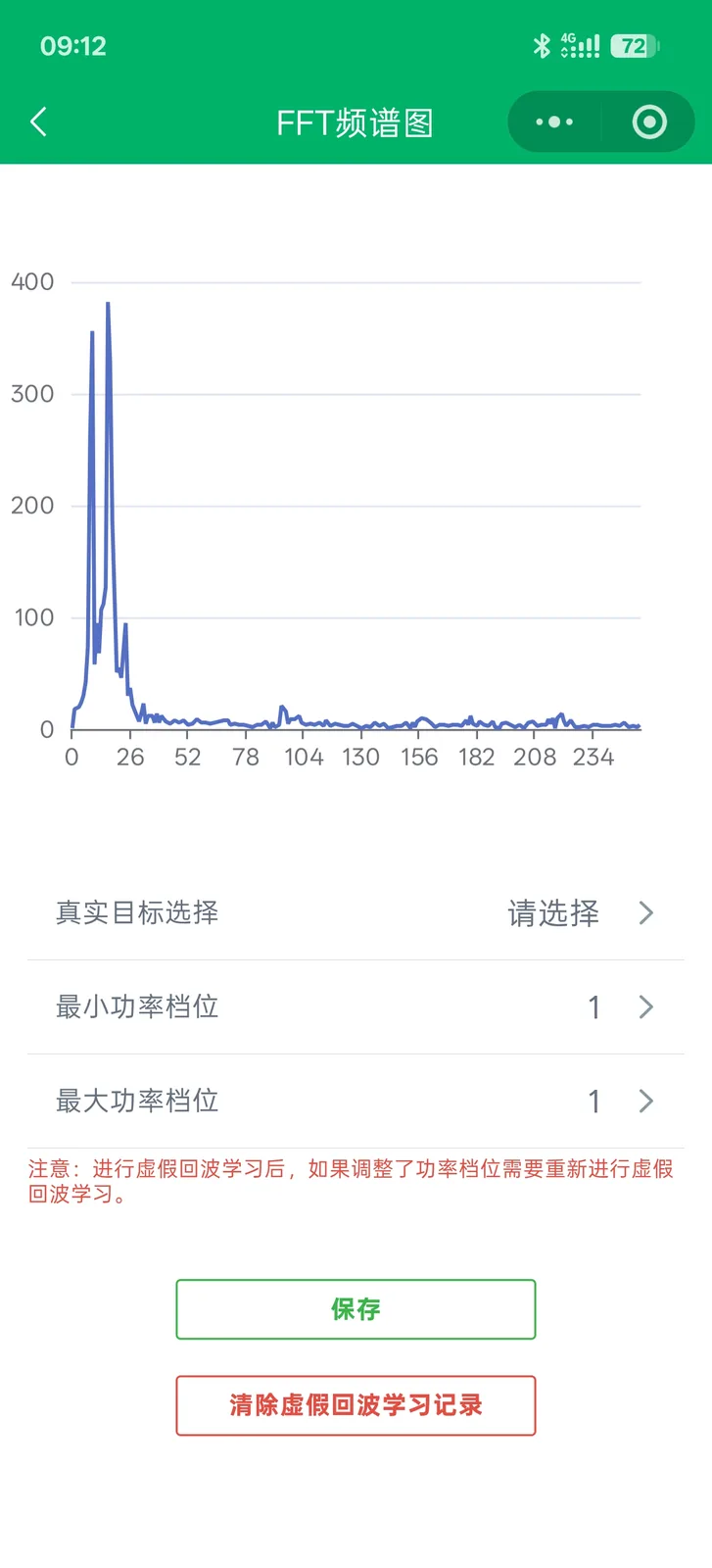
Echo spectrum: before and after

FFT spectrum before the restart showing two strong peaks
Before – two peaks of comparable height, on a 0–1,500 scale. The unit picked the wrong one.
FFT spectrum after the restart showing one dominant peak
After the restart – one peak, and the whole return now fits inside a 0–400 scale.

What this case teaches

  • Below about 30 cm, the second echo arrives almost as strong as the surface echo. There is very little delay to separate them, so the unit has to be right the first time – a wrong lock is easy and a filter has nothing to grab.
  • A restart is a legitimate first aid, not a fix. It re-runs acquisition and can pull the unit off a bad lock, but if the geometry still produces a strong second echo, the same lock can come back.
  • Do not compare peak heights across captures with different scales. Before and after use different vertical ranges; read the axis before you conclude anything.
  • When the range is this short, give the unit more distance. Raising the mounting height costs nothing and moves the surface out of the ambiguous zone.

Getting a reading that sits consistently below the real surface on a short-range tank? Send us the mounting height, the empty distance you measure by hand and a spectrum capture – a second echo shows up immediately on the trace.

Talk to an application engineer

Copyright @ 2026 JiaJia Eye

Weixin
No:89470
WhatsApp Inquiry Email WeChat
× WeChat QR code

Scan to add WeChat